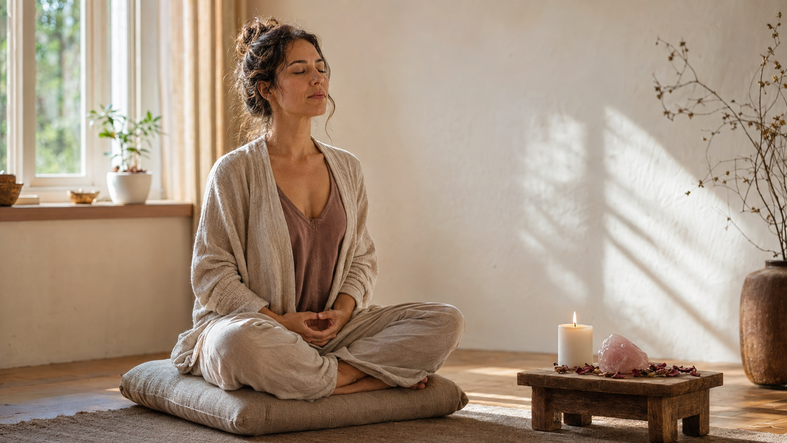
Your Altar – Creating Sacred Space

Putting together your altar is one of the most personal and important steps in your everyday spiritual practice. This will be the place that you focus your intentions and energy for manifesting benevolent and prosperous energy in your home. The altar space becomes a power source. Essentially, the more that you use your altar, the more energy will be accumulated, and the more power is created.
Choosing to have an altar in your home is one way to connect to your spirituality on a daily basis. It’s much easier to turn it into a daily practice when you have a sacred space set aside just for this purpose. Some people new to the idea of creating an altar worry that they won’t have enough space, that they won’t know how to do it, or that they won’t be able to create a proper ritual space. We’re going to cover all of that today and help you see why you need a sacred altar space of your own and how you can do it today with things you already have.
What is an Altar?
First, let’s get down to basics and discuss what an altar is. An altar is a sacred space for spiritual people to use for rituals. They have been used for many centuries by different spiritual and religious beliefs and in other religious ceremonies and holy architecture. Historically, the altar would sometimes be the site for a sacrifice or an offering to a God or Goddess. Every religious tradition has its own version of the altar and how it is used.
However, altars don’t have to have anything to do with religion at all. They are a way for you to connect with your spirituality, and they can be just as personal and unique as the people creating and using them. Altars are found in homes, gardens, Catholic churches, Buddhist temples, yoga studios, and more. If you’d like to build one in your own home, then you are not bound by any rules or requirements.
If you’re limited on space, it can be a small altar. Some people choose to turn an entire room of their home into an altar space. Still, others have a type of “mobile altar” that they can take with them when they travel or have with them in their bag when they go to work. You may choose to have more than one altar, or you can create altars for dedicated purposes, such as a health altar or a money manifestation altar. Again, there are no limits. You can just do what feels right to you.
But next, we’re going to talk about some tips and ideas for creating your sacred space at home. If something here resonates with you, feel free to use it. And if it doesn’t, then you can toss it. Again, we’re not here to tell you what to do, but just to guide you through some potential ideas. What you make of it is completely up to you!
Location, Location, Location
The first step to creating your altar is to decide where you want to put it. Depending on your living situation, you may be limited on space. Your altar does not have to be so grand as to devote an entire room. A little table, the top of a dresser, a shelf, or even the inside of an armoire will do. Remember, this is truly your personal power spot, so make sure that it is an area that will not be disturbed. You also want to choose an area that you know you will be able to access when you want to or need to.
Making your altar is an important part of the process because it is a sacred act in and of itself. You need to create a space that you are drawn to and that you will want to use again and again in a meaningful way. In general, your altar should be out of the way of high traffic areas in the household to minimize distractions or interruptions. If you burn candles, incense, or other things at your altar, then you want it to be in a space with good ventilation, too.
Cleansing the Area
Once you’ve decided on a location, you need to cleanse the energy in the space. Prior to setting up the altar, you will want to cleanse the space with a smudge. You can use a smudge made from white sage, cedar, or Palo Santo, just to name a few. Make sure to have a fireproof bowl or abalone shell with sand for the smudge stick. Consecrate the altar by connecting in with the universe, Source, or your higher power and requesting to bless the space as your own, imbue it with positive energy and banish any negative energy surrounding it. Finish the dedication by burning sweetgrass to lock in the positive energy.
Set the Space
You may wish to cover the altar with a cloth. The cloth can be plain, a fabric created on a loom, or you can adorn it with symbols that are sewn on or hand-drawn. Have fun with this. The more that you personalize your altar, the more powerful it will be. You can always decide to change this later so don’t get too hung up on what type of cloth you use. You can pick something now, then replace it later if something else calls to you. Your altar will always grow with you.
When working with the altar, it is a good idea to have a working cloth to place on the altar when using wax or oil. It is a good practice to keep your altar cloth clean. If the cloth gets dirty, promptly clean it.
Dress It Up
You can put anything that you want on your altar. Each item should have some significance to you personally. It is common practice to include items that represent the 4 elements of Earth, Fire, Water, and Air or the 4 directions; north, south, east, and west. You can include religious icons, pictures of friends or family that have crossed over, mandalas, or other symbology.
Here are some examples of things you might put on your altar:
- sacred items
- items that represent the elements
- items to represent each of the senses
- prayer beads or mala (or rosary beads, if you use those)
- Yantras (visual representations of deities)
- oracle cards or Tarot
- sacred texts
- pieces of art that speak to you
- photos of importance
- a journal
Creating the Ritual Altar
For the element of Earth, you can use soil, crystals, stones, and fresh flowers. For the element of Air, you can use feathers, incense, aromatic mists, or essential oils. For the element of Fire, you can use candles. For the element of Water, a bowl or chalice filled with water or ritual wine will work. In addition, many work with the element of Spirit, or Akasha. Spirit can be represented by the pentacle, angels, butterflies, cauldron, God/Goddess image, and other metaphors of the soul or spirit. We will go into more depth on the elements and the distinguishing features of altars for various spiritual paths in future blogs.
Conclusion of Creating Your Altar
Once you have created this sacred space within your home, you can continue to add to it and grow in time. As you practice your spiritual beliefs more, you may find that certain items move in or out of your altar. This is okay. Again, your altar will grow with you over time. Be open to the ebbs and flows, and also to your own intuition telling you when certain objects should be added or taken away. Your altar space is personal to YOU. Do what feels right to you and feel the energy and power of your space grow each time you use it.